
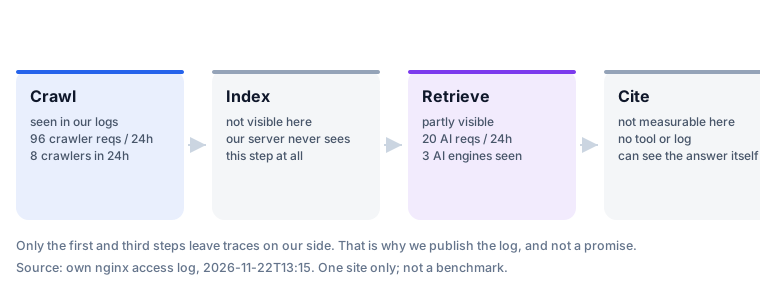
Most teams believe an AI engine cites the page that ranks highest in classic search. That's the misconception worth killing first. An AI citation is a link or named source an answer engine attaches to a generated response. Engines pick those sources from their own retrieval and ranking pipeline, not from your position in a search results list. The correction is simple: you earn citations by being easy to retrieve, easy to quote and easy to verify, not by winning a ranking race.
AI engines pick sources through retrieval and grounding, not ranking alone
Answer engines run retrieval first. A retrieval step is the stage where the system fetches candidate documents for a question before it writes anything. Google documents this pattern in its own material on AI Overviews and grounding, and Bing describes a similar retrieval-and-grounding flow in its Webmaster Guidelines. The engine then scores candidates and quotes the ones it trusts.
So the citation is a byproduct of retrieval plus grounding. Grounding means tying each generated sentence back to a fetched source. If your page never enters the candidate set, no amount of on-page polish matters. If it enters but the key sentence is buried in paragraph nine, the engine picks a cleaner competitor.
Put simply: get fetched, get parsed, get quoted. Each step has its own failure mode, and teams often fix the wrong one.
Crawler access and server-rendered HTML decide whether you're in the candidate set
Start with the boring technical layer. Crawlers follow robots.txt rules from the Robots Exclusion Protocol (RFC 9309, 2022). If your file blocks the crawler that feeds the answer engine, the page cannot be cited, full stop. Check the user-agent tokens before you touch a word of copy.
Next, confirm the page renders without JavaScript. Google's own documentation on JavaScript SEO states that rendering is a second wave and can lag crawling. A page that only shows its main text after client-side rendering risks being fetched empty. Server-rendered HTML with the answer visible in the source is the safer default.
Then check structure. Headings, lists and short paragraphs give a parser clean boundaries. A 900-word wall of text with one heading is harder to segment than the same content split under question-style h2 tags. Segmentation matters because engines quote passages, not whole pages.
Quotable passages answer one question and stand alone
A quotable passage has three traits: it answers one question, it stands alone without context, and it names its subject. Compare these two openings on a page about return windows.
- Non-citable: "We know how frustrating it can be when things don't work out, which is why we've built a process around you."
- Citable: "Acme Tools accepts returns within 30 days of delivery. Items must be unused and in original packaging."
The second version survives being lifted out of the page. The first collapses without the surrounding marketing. That lift test is the single most useful edit you can make: read each paragraph as if it were the only thing an engine saw.
Numbers and named conditions help too. "Within 30 days" beats "a generous window". "GB/T 7106-2019" beats "industry-standard testing", provided you add the year and note that the current in-force version prevails. Specifics are easier to verify, and verifiable sentences are easier to ground.
| Signal | What practitioners often assume | What the check actually shows |
|---|---|---|
| Search ranking | Position 1 gets cited most | Ranking helps, but retrieval and passage quality decide the quote |
| Word count | Longer pages win | Passage clarity wins; length alone is not a factor |
| Schema markup | Schema forces a citation | Schema aids parsing and entity clarity; it does not ensure inclusion |
| Freshness | Newer always beats older | Freshness matters for time-sensitive queries; stable facts age well |
| Crawler access | If Google can crawl it, everyone can | Each engine has its own crawler and rules; check each one |
Trust signals engines can check cheaply raise your odds
Engines lean on signals they can check cheaply. A clear author byline, a dated update, a named organisation and a contact page all reduce the risk of quoting a low-trust source. Google's Search Quality Rater Guidelines (the current version prevails) describe experience, expertise, authoritativeness and trust as evaluation dimensions, and while raters are human, the signals they look for overlap with what automated systems can parse.
Entity consistency is the quiet one. If your company name, address and service description differ across your site, your LinkedIn page and your Google Business Profile, an engine has to guess which version is true. Keep them identical. This is unglamorous work, and it moves the needle more than another blog post.
Citations from other sites still count. An engine that sees the same claim on three independent sources has more reason to trust it than a claim that appears once. There is no public figure for how much third-party corroboration shifts citation rates.
Question headings and short paragraphs let engines lift the answer
Use a question as the heading, then answer it in the first sentence under that heading. This mirrors how people prompt engines and how engines segment pages. A reader scanning the page benefits too, so nothing is lost.
Add a short summary table when you compare options. Tables survive extraction well because rows and columns carry their own labels. Add a definition sentence the first time a technical term appears, so a lifted quote still makes sense out of context.
Keep paragraphs to about four lines. Long paragraphs hide the sentence that matters. If a paragraph has two ideas, split it. That single habit improves both human reading and machine parsing.
Measure citations with server logs and a fixed monthly check
There is no official citation report yet. You have to build the measurement yourself. Start with server logs: filter for known AI crawler user agents and count fetches per URL per week. Cloudflare publishes a list of verified bots, which gives you a starting point for the filter.
Then run manual checks. Pick ten questions your buyers actually ask, ask them across the engines you care about, and record which sources appear. Do this on a fixed day each month so the comparison holds. Two things to expect: answers vary between runs, and a site new to a topic should expect crawl activity to grow over the first weeks rather than days.
Watch referral traffic too. Some engines pass clicks; others do not. A rise in branded search after an answer starts citing you is a weak but real signal.
Five common myths about AI citations don't survive a check
Myth one: schema markup gets you cited. Structured data from schema.org helps engines understand entities, products and FAQs, but it is an input to parsing, not a citation switch. Myth two: llms.txt is a standard. It is a proposed file with no ratified standard behind it, so treat it as an experiment.
Myth three: blocking AI crawlers protects your content. Blocking removes you from the candidate set entirely. If your goal is attribution, blocking works against you. Myth four: one big pillar page covers every query. Engines quote passages, so ten focused pages usually beat one sprawling page.
Myth five: citations are permanent. They are not. Answers change as indexes refresh and competitors publish. Treat a citation as a current state, not an asset you own.
Bottom Line
- An AI citation is a source an answer engine names or links in a generated answer; it comes from retrieval and grounding, not from ranking alone.
- Check crawler access first, then server-rendered HTML, then passage-level clarity. Fix them in that order.
- Run the lift test on every paragraph: if it cannot stand alone, rewrite it.
- Keep entity details identical across your site and external profiles.
- Measure with server logs plus a fixed monthly manual check; there is no official citation report.
- Schema and llms.txt help or experiment, but neither ensures a citation.
Key Facts at a Glance
- Crawler rules follow RFC 9309 (2022); the current in-force version prevails.
- Google's JavaScript SEO documentation confirms rendering happens after crawling, so server-rendered text is safer.
- Search Quality Rater Guidelines use experience, expertise, authoritativeness and trust as evaluation dimensions.
- schema.org vocabulary aids parsing; it is not a citation ensure.
- Cloudflare publishes a verified bots list you can use to start a log filter.
- No official AI citation report exists; measurement is manual plus log-based.
What content gets cited by AI most often?
Passages that answer one question in a standalone sentence, with a named subject and a specific detail such as a date, number or condition. Marketing copy that needs surrounding context rarely survives extraction.
How do AI engines choose which sources to cite?
They retrieve candidate pages, score them, then ground each generated sentence in a fetched source. Access rules, rendering, passage clarity and trust signals all affect whether your page makes the cut.
Can I track when AI cites my content?
Not through an official report. Use server logs filtered by known AI crawler user agents, plus a fixed monthly manual check of the questions your buyers ask across each engine.
Does content length affect AI citations?
Not directly. Engines quote passages, so a clear 600-word page can beat a vague 3,000-word one. Structure and standalone sentences matter more than total length.
Does schema markup ensure a citation?
No. Structured data helps engines parse entities and relationships, but it is an input to understanding, not a switch that forces inclusion in an answer.