
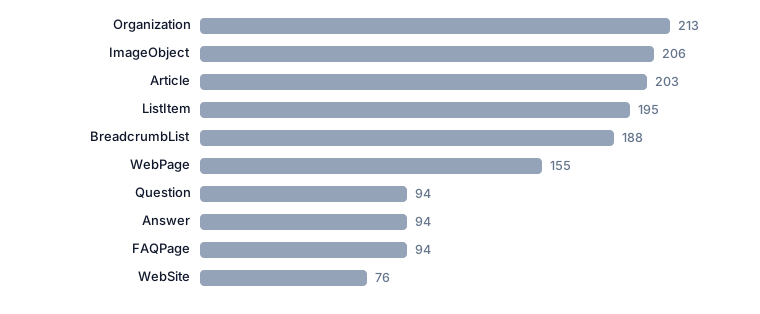
Google's documentation lists dozens of supported rich result types. Most sites qualify for only a handful, because eligibility depends on page type, not on how much markup you add. Structured data is a machine-readable description of what a page contains, written in a shared vocabulary. It changes eligibility, display and how clearly machines identify your entity. It does not change ranking position on its own. This guide answers the buyer questions in order, so you can decide where markup earns its keep on a B2B site and where it doesn't.
Schema markup changes eligibility and clarity, not ranking position.
Schema markup is the shared vocabulary at schema.org that lets you label page elements — a product, a price, an FAQ answer, an organization — in a way search engines and AI systems can read. Google's Search Central guidance on structured data says markup helps it understand page content and can make a page eligible for rich results. The same guidance says a marked-up page may still not appear as a rich result.
That distinction matters for B2B teams. A pricing page with correct Product and Offer markup does not move up the results page because of the markup. It becomes eligible to show price and availability in a rich result, and it gives an AI answer engine a clean, parseable statement of what you sell and at what price. Eligibility and clarity are the changes; position is not.
Put simply: schema enables, it doesn't rank. Check eligibility and entity clarity first, because those are the levers markup actually moves. Ranking movement usually comes from content, links and technical health, not from adding JSON-LD.
JSON-LD is the lower-risk default because it lives in one block.
JSON-LD is JavaScript Object Notation for Linked Data: a block of JSON placed in a <script type="application/ld+json"> element that describes the page. Microdata and RDFa embed the same vocabulary inside HTML attributes, mixed into the visible markup. Google's structured data documentation recommends JSON-LD, and its own examples use it. Schema.org publishes the vocabulary itself; the syntax choice is a separate decision.
The practical difference is maintenance. JSON-LD sits in one block, so a developer can read, diff and update it without touching layout. Microdata is spread across tags, so a template change can silently break it. For a B2B site with a CMS and a small team, JSON-LD is usually the lower-risk default.
| Question | JSON-LD | Microdata / RDFa |
|---|---|---|
| Where the markup lives | Separate script block | Inside HTML attributes |
| Google recommendation | Recommended format | Supported, not preferred |
| Risk when templates change | Low — block is isolated | Higher — markup is tangled with layout |
| Ease of review | Readable as one object | Requires reading rendered HTML |
| Strong fit | Most CMS and headless setups | Legacy templates you cannot easily change |
There is no public figure for how many sites still run Microdata in 2026; the choice should rest on your template setup, not on a trend. If your CMS already outputs JSON-LD, keep it and fix the content inside it.
Rich results and AI answers read the same markup for different jobs.
A rich result is an enhanced search listing — stars, prices, FAQ dropdowns — that Google shows when a page is eligible and selected. An AI answer is a generated response from a system such as an AI assistant or an AI Overview, built from retrieved pages. Both read structured data, but they use it differently. Google's rich result reports in Search Console show which types your site qualifies for and which have errors.
For AI systems, markup helps most when it resolves ambiguity. If your page says "we offer support plans" and the JSON-LD says Service with a name and provider, a retrieval system has a cleaner fact to work with. No AI platform has published a statement that a specific markup type ensures citation in its answers. Treat AI citation as a clarity benefit, not a switch. The markup makes the entity and the offer easier to parse; whether a given engine cites the page depends on retrieval, relevance and its own ranking logic, which you do not control.
Markup serves entity clarity, not keyword density.
Entity clarity means a machine can tell which real-world organization, product or person a page is about, and can link it to the same entity described elsewhere. Schema.org's Organization type with name, url, logo and sameAs properties is the usual starting point. The sameAs property points to authoritative profiles — a LinkedIn company page, a Wikipedia entry if one exists — so the machine can connect the dots.
Keyword density is a count of terms; entity clarity is a statement of identity. Markup serves the second. A page that repeats "industrial pump supplier" ten times tells a machine less than one Organization block that names the legal entity, the URL and two matching profiles.
This is where small B2B sites often win. You do not need volume to be unambiguous. You need one consistent name, one URL and matching profiles, repeated across pages and external listings.
Markup must match visible content, and two validators check different things.
The visible-match rule is the one to internalize: markup must describe content a user can see on the page. Google's structured data policies say markup must be representative of the visible page content, and violating that can lead to a manual action. If the JSON-LD lists a price the page doesn't show, fix one or the other.
Validation has two layers. The Schema Markup Validator checks whether the JSON-LD parses against the schema.org vocabulary. Google's Rich Results Test checks whether the page is eligible for a specific Google rich result. They answer different questions, so run both.
A self-check list you can run before publishing:
- Does every property in the JSON-LD match something visible on the page?
- Does the
@typematch the page's actual purpose — Article for an article, Product for a product page? - Are required properties present for the type, per Google's documentation for that rich result?
- Does the organization name match the name on your About page and external profiles?
- Does the Schema Markup Validator return zero errors, and the Rich Results Test show the expected type?
- Does the markup still render after a template or CMS update?
Schema decays. A theme update, a migration or a new field can drop or duplicate the JSON-LD block. A quarterly check in Search Console's rich results report catches most of it.
Do markup where the page type maps to a rich result or identity is ambiguous.
Markup matters most when the page type maps to a supported rich result or when identity is genuinely ambiguous. It matters least when the page is a generic blog post with no eligible type and no entity confusion.
| Page type | Markup worth doing | Why |
|---|---|---|
| Home / About | Organization with sameAs | Entity clarity across the site |
| Product or service page | Product or Service with Offer | Price and availability eligibility |
| FAQ page | FAQPage | Eligibility for FAQ rich results, where Google still shows them |
| Article / guide | Article with author and date | Clear authorship and freshness signals |
| Generic category page | Usually skip | No matching rich result, low clarity gain |
Google's own documentation notes that FAQ rich results are shown only for well-known authoritative government and health sites, so FAQPage markup on a B2B blog may not produce a visible rich result. It still helps machines parse the Q&A structure. Set expectations accordingly.
If you have limited engineering time, do Organization first, then the page type that carries your commercial offer. Leave the rest until those two are stable and validated.
Key Facts at a Glance
- Core change from structured data: eligibility and machine clarity, not ranking position.
- Recommended format: JSON-LD, per Google's structured data documentation.
- Policy rule: markup must match visible page content.
- Entity clarity tool:
OrganizationwithsameAslinks to authoritative profiles. - Maintenance cadence: validate on publish, re-check quarterly.
Does schema markup improve rankings?
Not directly. Google's documentation frames structured data as a way to help it understand content and qualify for rich results, not as a ranking factor. Ranking movement usually comes from content, links and technical health.
Which schema type should I use first?
Start with Organization on the home or About page, including name, url, logo and sameAs. Then add the type that matches your commercial page, such as Product or Service.
How do I validate JSON-LD structured data?
Run the Schema Markup Validator to check the JSON-LD against the schema.org vocabulary, then the Rich Results Test to check Google eligibility for a specific rich result. They answer different questions.
Does structured data help with AI search?
It can make entities and offers easier for retrieval systems to parse. No AI platform has published a statement that a specific markup type ensures citation in its answers. Treat it as a clarity benefit, not a switch.
Can bad schema hurt my SEO?
Markup that misrepresents visible content can lead to a manual action under Google's structured data policies. Broken or duplicate JSON-LD after a template change can also cause validation errors and lost eligibility.